You may have heard about “robo-advisors” like Betterment and Wealthfront. Robo-advisors are investment firms that use computer algorithms to invest your money (“robo” refers to a computer investing for you versus an expensive adviser).
You’re probably wondering if they are a good investment and if you should use one. As a NYT best-selling author on personal finance, let me break it down for you.
NOTE: If you’re looking for more information on investing, I recommend checking out these other articles I wrote:
OR, make it easy on yourself, and just enter your email to get my Ultimate Guide To Personal Finance below.
Why Robo-Advisors Became Popular
Robo-advisors took the elite financial planning services offered to clients of financial advisers and full-service investment firms like Fidelity and made them accessible to the average person.
You know how Uber made private cars more accessible and convenient than taxis? That’s sort of what robo-advisors have done to the investment industry.
Robo-advisors implemented new technology to offer investment recommendations for low fees. They improved the user interface so you can sign up online, answer a few questions, and know exactly where to invest your money in a few minutes.
And they personalized the experience so you can add in your goals—like when you want to buy a home—and automatically allocate money aside for it.
Are Robo-Advisors a good Investment?
I have a strong opinion on robo-advisors:
While they are good options, I don’t think they are worth the costs, and I believe there are better options.
As an example, I specifically chose Vanguard and have stuck with them for many years.
Let me explain the pros and cons of robo-advisors so you can make your own decision.
Pros & Cons Of Robo-Advisors
Pros To Using A Robo-Advisor
In the last few years, robo-advisors have become increasingly popular for three reasons:
■ Ease of use. They have beautiful interfaces on the web and on your phone. They offer low minimums and make it easy to transfer your money over and get started investing.
■ Low fees. In general, their fees started off lower than those of full-featured investment firms like Fidelity and Schwab. (Those firms quickly realized their competition and lowered their fees accordingly, while the fees at low-cost firms like Vanguard have always been low.)
■ Marketing claims. Robo-advisors make lots of marketing claims. Some are true, such as their ease of use. Some are disingenuous, bordering on absurd, like their focus on “tax-loss harvesting.”
As you’ve probably realized if you’ve read any of my other blog content on personal finance, I’m a huge proponent of anything that expands the use of low-cost investing to ordinary people.
Long-term investing is a critical part of living a Rich Life, so if companies can strip away complexity and make it easier to get started—even charging a generally low fee—I’m a fan.
These robo-advisors have added phenomenal features that are genuinely helpful, including planning for medium-term goals like buying a house and long-term goals like retirement.
What’s more, you can often tell how good something is by who hates it.
For example, Bank of America hates me because I publicly call them on their bullshit. Good! In the case of robo-advisors, commission-based financial advisers generally hate them because they use technology to achieve what many advisers were doing—but cheaper.
Advisers’ logic on this is not especially compelling. Financial advisers essentially say that everyone is different and they need individual help, not one-size-fits-all advice (untrue— when it comes to their finances, most people are mostly the same).
Robo-advisors have responded by adding financial advisers you can talk to over the phone. Traditional financial advisers say their advice provides value beyond the mere returns. (My response: Fine, then charge by the hour, not as a percentage of assets under management.)
Robo-advisors emerged to serve an audience that was previously ignored:
young people who are digitally savvy, upwardly affluent, and don’t want to sit in a stuffy office getting lectured by a random financial adviser.
Think of an employee at Google who doesn’t know what to do with their money, which is just sitting in a checking account. Robo-advisors have done a good job of appealing to that audience.
But the real issue here is “Are they worth it?”
My answer is no—their fees don’t justify what they offer. The most popular robo-advisors have superb user interfaces, but I’m not willing to pay for that. Since they opened, many robo-advisors have dropped their fees, sometimes even lower than Vanguard.
The Problem With Robo-Advisors
But there are two problems with that: In order to run a sustainable business on fees lower than 0.4 percent, they have to offer new, more expensive features and manage massive amounts of money—we’re talking trillions of dollars.
As an example, Vanguard currently manages nine times more than Betterment and ten times more assets than Wealthfront. That sheer, massive scale is a huge competitive advantage to Vanguard, which built itself over decades to sustain on tiny fraction-of-a-percentage fees.
New robo-advisors can’t sustain on those low fees unless they grow their business rapidly, which is unlikely. Instead, they’ve raised money from venture capital investors, who want rapid growth.
In order to attract more customers, robo-advisors have begun using marketing gimmicks like highlighting a minuscule part of investing, “tax-loss harvesting”—which is basically selling an investment that’s down to offset tax gains—that they blew up into a seemingly critically important part of an account.
Why Tax Loss Harvesting Isn’t That Important
This would be like a car manufacturer spending millions of dollars marketing a triple coat of paint as one of the most important parts of buying a car. Sure, tax-loss harvesting might save you a little money over the long term . . . but not a lot.
And in many cases, it’s unnecessary. It’s a “nice to have” feature, but hardly something on which you should base the important decision of choosing what firm to invest your money with.
Some robo-advisors have also begun offering products with higher fees, as the Wall Street Journal reported in 2018.
Wealthfront added a higher-cost fund of its own. The offering uses derivatives to replicate a popular hedge fund strategy known as “risk-parity.”
Some clients—joined by consumer advocates and rivals—quickly took to online forums to criticize the fund’s costs and complexity. They also took Wealthfront to task for automatically enrolling certain customers in the fund.
“I just looked at my account & it’s true. There was money moved into your ‘Risk Parity’ fund without my consent,” Wealthfront customer Cheryl Ferraro, 57 years old, of San Juan Capistrano, California, recently posted on Twitter.
“I had to go into my account and tell them I wanted my money moved out of that fund. It shook my confidence in them for sure,” Ms. Ferraro said in an interview.
This is the predictable outcome when a low-cost provider raises venture capital and needs to grow rapidly. It either finds more customers or finds a way to make more money from each customer.
The Bottom Line
I believe Vanguard has the edge, and I invest through them.
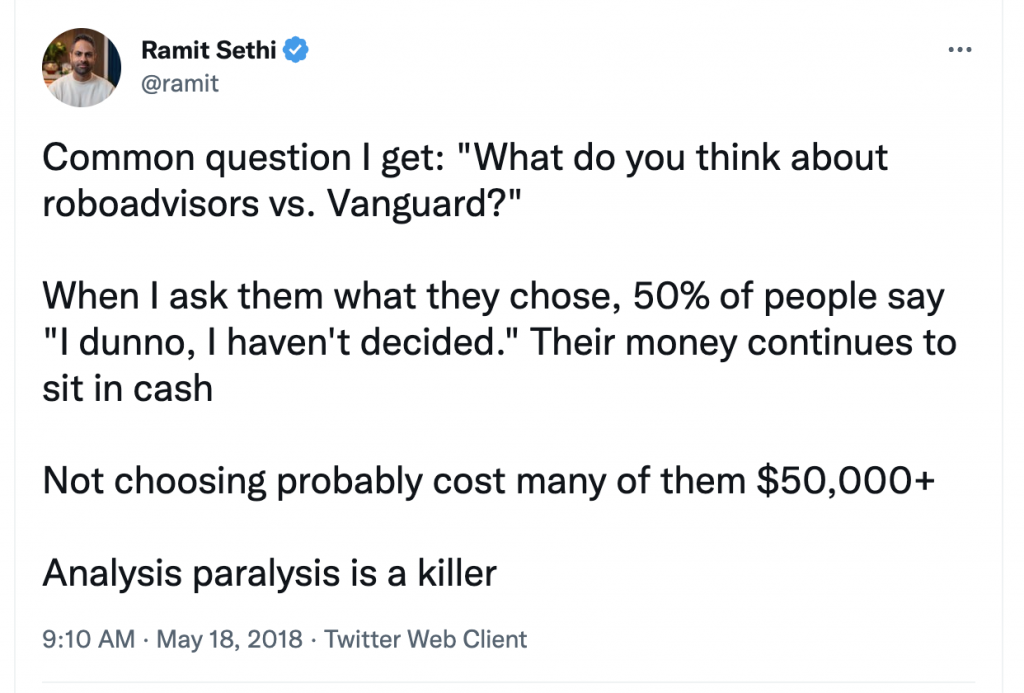
But realize this: By the time you’ve narrowed down your investing decision to a low-cost provider like Vanguard or a robo-advisor, you’ve already made the most important choice of all: to start growing your money in long-term, low-cost investments.
Whether you choose a robo-advisor or Vanguard or another low-fee brokerage is a minor detail. Pick one and move on.