Not all creatives are poets and painters. Some are accountants and bankers.
You may not realize it, but some of the most creative people are attracted to big piles of money. This particular brand of creativity explains why the banking sector seems to careen from crisis to crisis.
We all know we’re in one crisis now. But most don’t see that the creatives are busy setting up another.
Here’s what I mean…
Bank assets total almost $23 trillion. That’s enough money to attract some very creative minds.
Some of those free thinkers figured out a way to increase that pile of money by 27 times. They call it “derivatives.”
The total value of derivatives is $632 trillion, according to an estimate from the Bank for International Settlements (BIS). The BIS is the central banker’s bank, so it should have a good idea of how big that market is.
You might remember derivatives from the last global financial crisis. Subprime mortgages were sliced and diced into different derivatives that were then given AAA grades by ratings agencies. When home prices fell, that market collapsed and almost brought down the financial system.
Bankers and regulators learned from that crisis. They put rules in place to ensure that never happens again. Unfortunately, those rules aren’t enough to stop the current crisis, or the one fast approaching.
The Problem of Rising Rates
The current crisis is related to rising interest rates. Silicon Valley Bank and Signature Bank collapsed under the weight of higher rates. The Federal Deposit Insurance Corporation (FDIC) suffered losses of more than $22 billion in those failures.
Those losses need to be made up by banks that didn’t fail. But paying $22 billion to the FDIC would hurt banks’ profits. So, the creative minds went to work.
They noticed that banks were failing because the value of their long-term Treasury holdings were declining. Those losses led to panic among depositors who rapidly withdrew cash from the banks.
If the banks had been able to hold their Treasury notes to maturity, there wouldn’t have been a problem. Panic created a run on the bank, and banks failed because of emotional responses rather than mismanagement.
All banks hold Treasury securities. Their holdings increased in recent years to meet regulatory requirements. Those are the regulations put in place to avoid a repeat of 2008.
Holding Treasurys is only a problem if interest rates rise. That started happening in 2021.
Bonds, including Treasurys, lose value when rates rise. This led to paper losses for the banks. That sparked panic at the failed banks. But it’s also a problem that many banks have.
Fortunately, creative bankers have a solution.
A New Way for Banks to Pay FDIC
To solve the current crisis and cause the next one, creative accounts would like to pay the FDIC assessment with Treasurys instead of dollars.
This would solve the FDIC’s problem. It would also benefit banks. In fact, banks could turn a profit on the deal.
Remember, when rates rise, the value of bonds falls. If the FDIC accepts Treasurys, the banks could pay with securities that are currently worth maybe $0.90 on the dollar and give them to the FDIC at full price.
The FDIC could hold the securities to expiration and declare their value is a dollar since there is no risk of default in the Treasury market.
It’s a nice solution … at least on the surface.
Banks win since they clear paper losses off their books. Creative bankers will get bonuses for generating profits. The FDIC wins because it gets its reserves replenished. (And that’s really all that the FDIC wants.) Consumers win because banks become safe again … for a time.
And here’s where the real problem lies. This solution is merely a short-term fix to the last problem the banking system faced. And that problem was created by a solution to the previous crisis.
It’s reasonable to believe that this current patch-up will only create another complication that festers into our next crisis.
Banking is now a crisis carousel. But for the select few who understand how to ride it, it’s a chance to profit…
Adam O’Dell and his team have been studying this vicious banking cycle and discovered a way for individual traders to both protect and build their wealth from an ongoing wave of bank failures.
Elite hedge funds and short sellers have already profited handsomely from the recent round of bank failures. These investors saw the problems brewing in these banks before anyone else and made trades against them to profit from their downfall.
Adam knows of a similar, but much safer way these traders used to make $7 billion in profit back in March as Silicon Valley Bank and Signature Bank went down.
But those collapses were just the beginning. Adam O’Dell’s latest research shows that as many as 282 banks are at high risk of failure right now. As he tracks the situation, he’ll soon reveal his method for a number of strategic trades against these banks.
As more banks head for the cliffs, Adam is preparing to show us how we can strategically position ourselves to benefit as well.
To learn how you can avoid big hits to your portfolio by dumping certain stocks on Adam’s list now and how to place a little-known “off Wall Street” trade to profit as they fall, click here.
Regards,Michael CarrEditor, One Trade
(From Barron’s.)
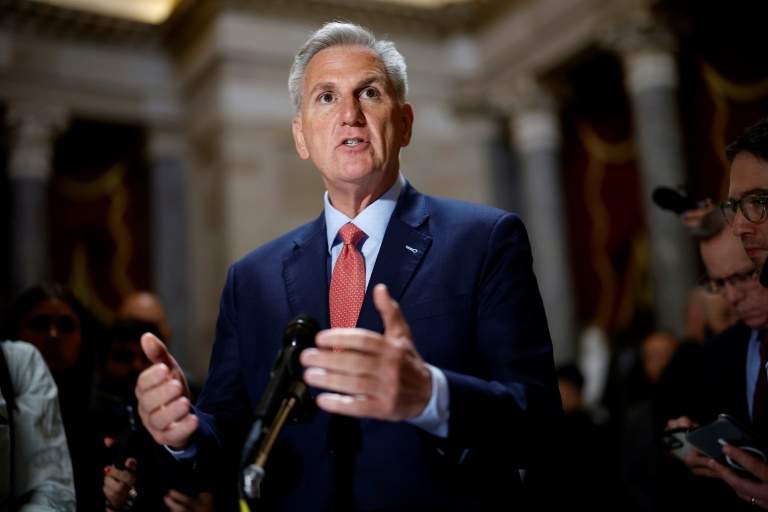
President Biden and House Speaker Kevin McCarthy walked out of their Monday meeting without an agreement.
But both seemed upbeat that a deal was reachable. In Biden’s words: “We reiterated once again that default is off the table and the only way to move forward is in good faith toward a bipartisan agreement.”
About that…
In roughly the time it took them to turn around, it all fell apart. Talks are now suspended, at least as of the time I’m writing this.
A deal that is “bipartisan” will likely be rejected by the right flank of the Republicans, who demand significant spending cuts. And also by the left flank of the Democrats, who aren’t likely to go along with their spending priorities getting slashed.
McCarthy’s position isn’t strong enough to alienate parts of his own party. It took him 15 rounds of voting to get the speakership, and he holds on to that job by a thread. So it’s not likely that McCarthy makes a deal with Biden and keeps his job.
In other words, McCarthy’s search for job security might see us stumble into default, or at least get closer than anyone wants.
If I were to hazard a guess, I bet we get a last-second deal that freezes spending at current levels for the next year or two. (Both parties would probably ignore this once it’s time to put the next spending bill together.)
And McCarthy loses the speakership.
In the absence of a deal like this, it’s possible Biden simply ignores the debt ceiling and issues new debt anyway. But even this means instability, and frankly, that’s the last thing we need right now.
Meanwhile, as Mike Carr pointed out in yesterday’s Money and Markets, corporate earnings show signs of that recession that’s been threatening for months.
Foot Locker, Home Depot, Target and even Walmart all noted a slowdown in consumer spending — a shift away from “fun” spending, and more towards basic necessities.
Oh, and remember that banking crisis that started with Silicon Valley Bank? Yeah, that never really went away either.
It’s safe to say we have a lot of potential landmines out there. That’s scary, of course, but it’s also potentially profitable … if you know how to play it.
And that’s where Adam O’Dell’s latest research comes in.
Adam has pinpointed 282 banks that are just as vulnerable as Silicon Valley, Signature and First Republic. But rather than simply sidestepping another banking failure, he’s looking to actually profit from it.
After the first round of banking issues in March, short sellers and elite hedge funds made $7.25 billion in profits. These investors saw the flaws in these banks before anyone else and placed strategic trades against them to profit from their downfall.
They did it again in the first two days of May, making $1.2 billion in profits after the collapse of First Republic.
Adam is getting in on that action … by pinpointing a list of stocks that you can profit from in the same way.
Want to learn more? Reserve your spot for Adam’s new webinar, releasing on May 31.
Regards,
 Charles SizemoreChief Editor, The Banyan Edge